We have exciting news to share! Real Deals has recognized SESAMm for Best ESG Tech for TextReveal® ESG Alerts at the Real Deals ESG Awards 2022! These awards focus on: 1. a mixture of demonstrable customer and revenue growth; 2. detailed overviews of how new initiatives, products, or services have aided the business and helped their clients
ESG monitoring is becoming increasingly critical as legislation and stakeholders focus on sustainability, positive impact initiatives, and CSR. Early detection of controversies and positive impact events for private and public companies is possible through natural language processing (NLP)-powered technologies. SESAMm's ESG and SDG Alerts use AI to give firms the ability to monitor millions of public and private companies worldwide, providing more objective indicators.
A big thanks to SESAMm's investors, partners, and clients
We thank our clients, investors, and partners for your support and patronage. Thank you for being such a big part of SESAMm; you're why we do what we do, and many of you have been involved since day one. And your generous and encouraging attitude has helped get us here today.
Of course, we're honored to earn the ESG Tech award at Real Deals ESG Awards 2022. We're also excited for our clients and partners. And while we have more work to do and clients to serve, we think the future looks bright for us, our partners, and our clients.
About SESAMm and TextReveal
SESAMm is a leading NLP technology company serving global investment firms, corporations, and investors, such as private equity firms, hedge funds, and other asset management firms. Through TextReveal, we give you NLP capabilities to generate your own alternative data for use cases, such as ESG and SDG, sentiment, private equity due diligence, corporation studies, and more. And with access to SESAMm’s massive data lake, made up of 20 billion articles and messages and growing, you can make better investment decisions.
Reach out to SESAMm
For a personal demonstration of our award-winning platform, reach out to a representative
The first and second parts of this series discussed the differences between public and private companies from the Environmental, Social, and Governance (ESG) and the United Nations Sustainable Development Goals (UNSDG) perspectives. In this part, we’re using IKEA as a prime example; we can explore how its private ownership impacts its sustainability practices and governance. This analysis aims to reveal how IKEA's strategies align with broader ESG goals, shedding light on the implications of private versus public company frameworks.
We chose IKEA as an example for this use case for two main reasons. Firstly, as a private company, it provides a suitable basis for comparison with other private companies in the same industry. Secondly, IKEA is known for promoting sustainable practices, such as using renewable energy, responsibly sourced materials, and minimizing waste. However, despite the company's claims about the eco-friendliness of its products, our goal is to investigate whether these claims and products are perceived as environmentally friendly. We also aim to identify any issues affecting any of its stakeholders beyond the environment.
ESG Industry Benchmark
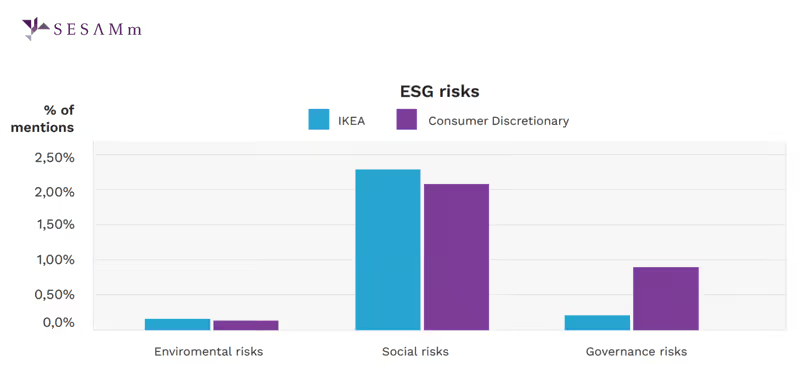
In our study, we focused on a detailed comparative analysis of IKEA's Environmental, Social, and Governance (ESG) risk mentions over the past three years, particularly in the context of the consumer discretionary sector. Our findings indicate a lower prevalence of environmental controversies both for IKEA and the sector overall. However, regarding governance risks, the consumer discretionary sector appears to encounter these issues more frequently than IKEA does.
Figure 1: ESG risks in IKEA and Consumer Discretionary.
On the other hand, IKEA stands out with a more significant presence of social risks than the sector average. This includes a notable number of product safety concerns, exemplified by instances of product recalls due to choking hazards, laceration risks, and even products infested with bugs. The analysis also brought to light several instances of human rights breaches at IKEA, particularly concerning privacy issues, such as data leaks and illegal filming incidents involving staff and customers. Labor rights violations are another area of concern, with instances ranging from union-busting activities to allegations of religious and gender discrimination within the company. Additionally, human capital risks are conspicuous, with mentions of strikes driven by dissatisfaction over wages and layoffs, as well as health and safety issues. Risks in customer relations have also been documented, including incidents of overcharging customers and discriminatory practices against certain customer groups.
Detecting ESG Risks Through the Industry SDG Lens
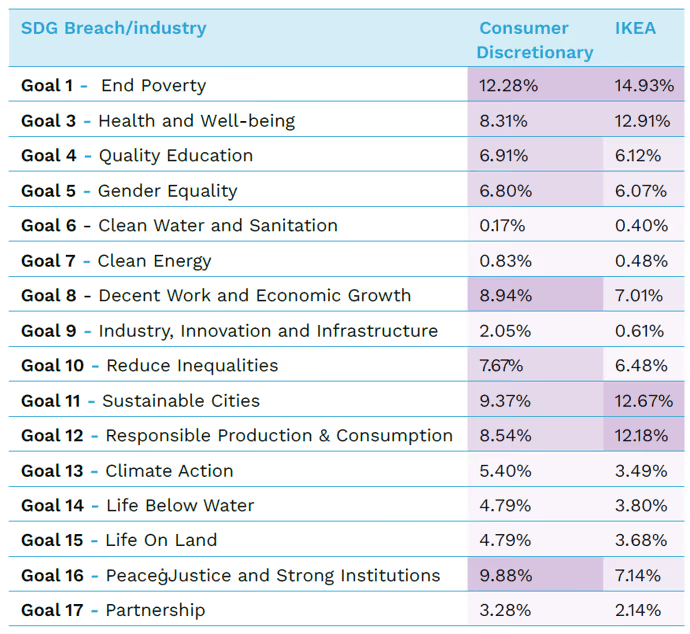
In our comparative analysis of IKEA's controversies against the average adverse behaviors in its sector concerning the Sustainable Development Goals (SDGs), we noticed both similarities and distinctions. A key finding is that Goal 1, "End poverty," features prominently for both IKEA and the sector, highlighting a common vulnerability to controversies under this goal.
These breaches predominantly pertain to issues around labor rights and human capital, aligning with the findings from our ESG controversy analysis. Additionally, a smaller yet significant portion of controversies is linked to internal control deficiencies within the company. This pattern suggests that both IKEA and its sector face similar challenges in addressing labor rights and human capital issues, contributing to breaches of Goal 1. In examining the differences, Goal 3, "Health and well-being," stands out for IKEA, exceeding the sector norm. This is largely attributed to numerous product recalls, alongside health and safety concerns related to IKEA's workforce. Moreover, in Goals 11 ("Sustainable Cities") and 12 ("Responsible Production and Consumption"), IKEA shows a higher-than-average proportion of controversies, mainly due to issues in human capital and customer relations. This highlights a specific focus on product safety and human capital challenges at IKEA, pointing to areas of heightened risk or difficulty compared to industry peers. Additionally, our study reveals distinct variations in Goals 9 ("Industry, Innovation, and Infrastructure") and 16 ("Peace, Justice, & Strong Institutions"), where IKEA shows a lower proportion of issues compared to the sector average. This suggests that, unlike its industry counterparts, IKEA has been more effective in mitigating risks in these areas.
Detecting ESG Risks Through the Industry SDG Lens
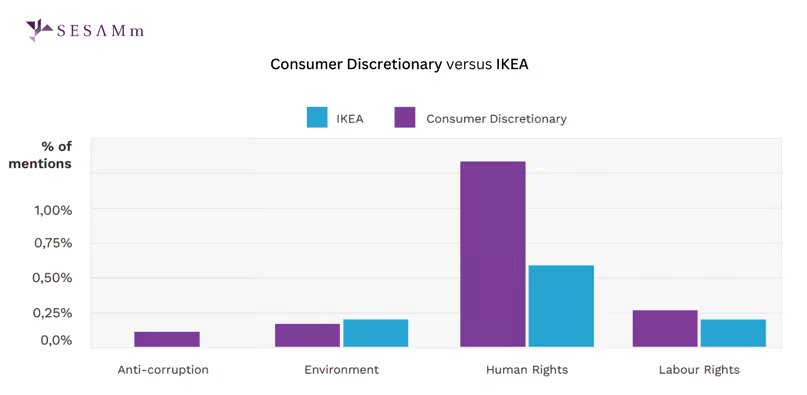
Our methodology analyzes the controversies detected for IKEA and maps them to identify which ones constitute breaches of the United Nations Global Compact (UNGC) principles.
Figure 2: UNGC principles in IKEA and Consumer Discretionary.
Consistent with the identified ESG risks, human rights breaches at IKEA are notably more prominent than the sector average. This is primarily due to multiple instances of privacy, security, and dignity violations, as well as issues in diversity & inclusion. Additionally, labor rights issues at IKEA, while exceeding the industry average, are not markedly higher. Our study also reveals that IKEA has a slightly higher proportion of breaches in the environmental pillar compared to its sector. These include incidents like gas leaks, allegations of greenwashing, and cases of illegal logging.
Conclusion
ESG controversies and breaches of SDG goals vary notably between public and private sectors. Public companies frequently encounter more visible and consistent ESG risks, while private companies, although subject to less scrutiny, experience significant impacts when controversies do occur. The case study of IKEA particularly sheds light on the unique challenges faced in product safety and human capital. This highlights the critical need for rigorous and proactive risk management strategies to maintain sustainable corporate practices tailored to the specific nature and scale of the entity in question.
Download the full report to discover how different sectors navigate regulatory pressures and sustainability challenges with real-world examples to guide your strategy.
Reach out to SESAMm
TextReveal’s web data analysis of over five million public and private companies is essential for keeping tabs on ESG investment risks. To learn more about how you can analyze web data or to request a demo, reach out to one of our representatives.
The direct-to-consumer (DTC) genetic testing industry has transformed personal health and ancestry exploration, offering consumers remarkable insights from their DNA. Yet rising ESG concerns around data privacy, ethical use, and regulatory compliance are reshaping this landscape, pushing companies to prioritize consumer trust. Once a leader, 23andMe now faces steep challenges with data security, public confidence, and corporate stability. Recent breaches, including a leak impacting 6.9 million users, have led to lawsuits, a $30 million settlement, and boardroom upheaval, casting uncertainty on the company's future. Meanwhile, competitors like Ancestry and MyHeritage, though contending with similar issues, have remained comparatively stable. How does 23andMe compare to its competitors when it comes to ESG concerns? Read on to find out.
23andMe: From Market Leader to Data Breach Fallout
23andMe initially led the DTC genetic testing market but has faced a series of challenges, mainly around data privacy. A major data breach in 2023 compromised 6.9 million users’ information, resulting in a $30 million settlement and reputational damage. Board resignations followed, highlighting corporate governance issues. These events underscore the need for strong data security and governance in sustaining consumer trust.
Ancestry: Customer Loyalty Tested by Rising Controversies
Ancestry has also faced privacy-related challenges, especially since its acquisition by Blackstone. Lawsuits claim the company misused consumer data without consent, violating privacy laws. Public backlash, such as from a controversial advertisement, has further affected Ancestry’s image. Yet, its solid user base has helped it remain stable compared to some competitors.
MyHeritage: Navigating Privacy Compliance Across Borders
MyHeritage, while facing fewer controversies than its peers, still encounters significant privacy scrutiny. Investigations in Norway and Denmark have raised questions about its compliance with data laws. Although MyHeritage’s controversies are less severe, maintaining regulatory compliance remains essential for its international operations.
The future of the DTC genetic testing industry depends on how effectively companies manage ESG risks. Companies like 23andMe, Ancestry, and MyHeritage can better protect consumer trust and build a foundation for sustainable growth in this scrutinized sector by prioritizing data security, strong governance, and compliance.
Reach out to SESAMm
TextReveal’s web data analysis of over five million public and private companies is essential for keeping tabs on ESG investment risks. To learn more about how you can analyze web data or to request a demo, reach out to one of our representatives.
Paris, France – June 25, 2024 – SESAMm, a leader in AI-powered text analysis for financial services, proudly announces its inclusion in the AIFinTech100 list by FinTech Global for the second consecutive year. This recognition highlights SESAMm's commitment to sustainability and ESG through the application of advanced AI technologies.
FinTech Global's annual AIFinTech100 list, now in its fourth year, showcases the top 100 AI companies that are revolutionizing the financial services industry. The list is carefully curated by a panel of industry experts who evaluate over 2,000 fintech companies worldwide. This year’s criteria focused on the transformative impact and the innovative use of generative AI in financial services, from banking and insurance to investment and customer experience.
"We are honored to be listed again on the AIFinTech100. This recognition highlights our leadership in employing AI to detect ESG controversies, helping our clients proactively manage risks and uphold sustainability commitments,” said Sylvain Forté, SESAMm’s CEO. “At SESAMm, we aim to transform financial analysis by ensuring it is as responsible as innovative."
FinTech Global director Richard Sachar said "SESAMm has been selected for the AIFinTech100 list due to their exceptional capabilities in ESG controversy detection using AI. Their technology plays a pivotal role in enabling the financial industry to address and navigate ESG risks effectively, marking a significant advancement in sustainable finance."
The inclusion of SESAMm in this year's AIFinTech100 comes at a time when the financial sector is increasingly relying on AI to enhance operational efficiencies and customer interactions. With AI investments in FinTech expected to reach $44.08 billion by 2024, SESAMm continues to lead the charge by providing cutting-edge solutions that address the complex needs of today’s financial institutions.
About SESAMm
SESAMm is an innovative fintech firm specializing in AI-powered text analysis for asset managers, private equity firms, and financial institutions. Its flagship product, TextReveal, offers actionable insights into ESG risks and investment opportunities, cementing SESAMm’s role as a leading provider of financial intelligence and predictive analytics.
For more information about SESAMm and its innovative solutions, please visit www.sesamm.com.
SESAMm’s AI Technology Reveals ESG Insights
Discover unparalleled insights into ESG controversies, risks, and opportunities across industries. Learn more about how SESAMm can help you analyze millions of private and public companies using AI-powered text analysis tools.
Stay ahead with the latest in ESG and AI intelligence
Join our mailing list to receive new reports, event invites, and updates from SESAMm directly to your inbox.










.png)